
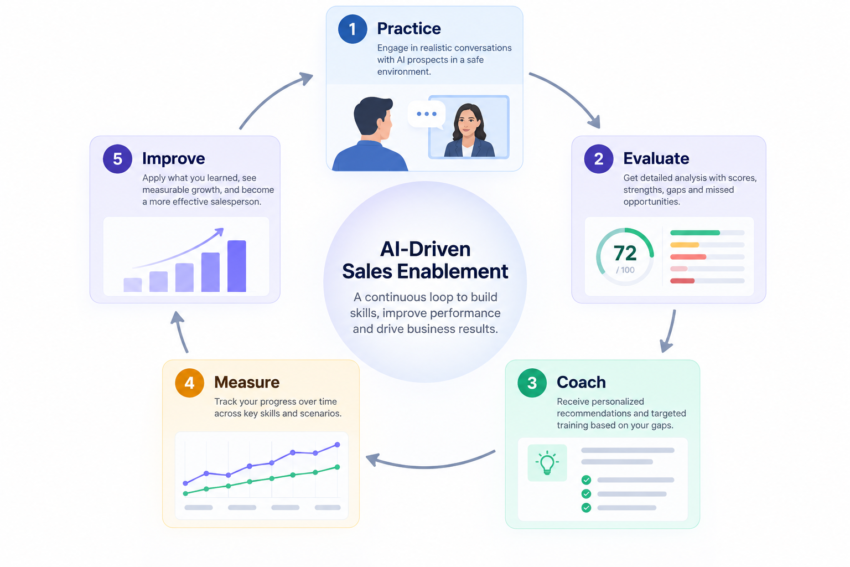
How AI can transform sales training into a personalized, scalable, and measurable experience.
Sales are driven by people. They rely on good conversations, the right questions, and a deep understanding of the customer’s challenges. However, consistently developing these skills across the entire team is a challenge. Managers rarely have enough time to listen to every call, conduct realistic simulations, provide detailed feedback, and track each professional’s progress over time.
This challenge led me to a personal project: creating an AI-powered sales coaching platform, conceived from a simple question. What if AI could shorten the cycle between practice, feedback, and improvement?
The goal wasn’t to create just another chatbot. I wanted to explore how Generative AI could integrate into a real sales enablement workflow, combining realistic practice, structured assessment, continuous coaching, and measurable development.
A Realistic AI Prospect for Real Conversations
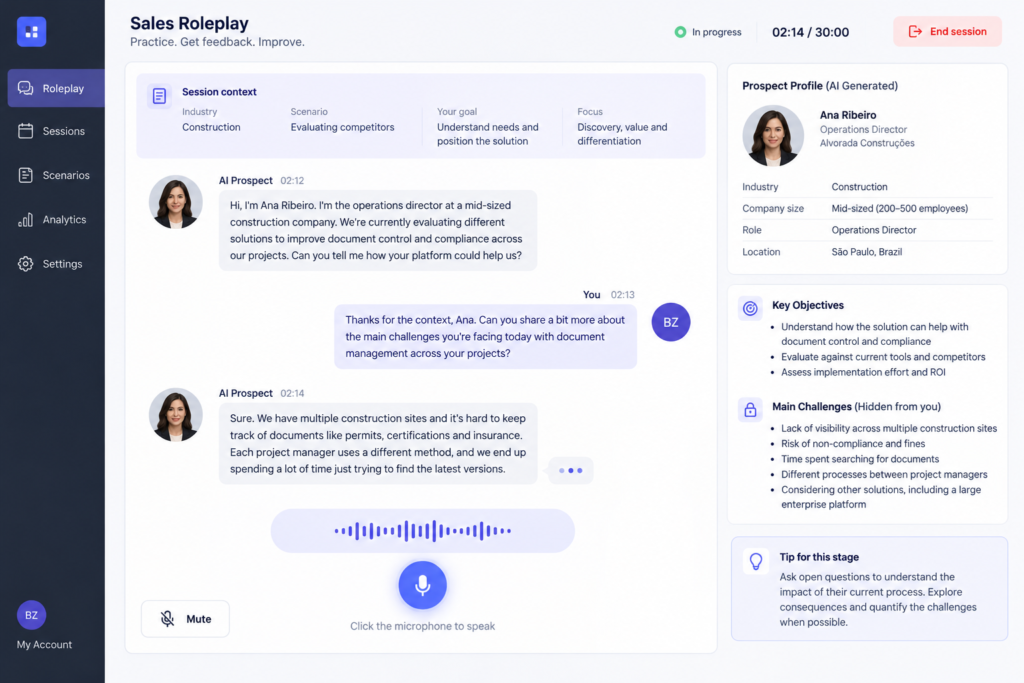
The first part of the platform is an AI-driven roleplay simulation. Instead of practicing from a fixed script, the user converses with a dynamically generated prospect based on the industry, job role, scenario, difficulty level, and supporting context defined for the session.
The interaction takes place via voice. The salesperson speaks naturally, the prospect responds, and the conversation evolves based on what is actually being asked. This is crucial because realistic sales training shouldn’t reward someone simply for following a predetermined sequence.
The simulated prospect also possesses layers of information. A business problem might initially surface at a superficial level, while deeper operational consequences, financial impacts, or issues of urgency are revealed only when the salesperson asks better questions. This fosters a key training behavior: the user must uncover the problem rather than being handed the full story right from the start.
This is where Generative AI proves more useful than a traditional training script. The model isn’t just generating language; it is participating in a controlled business scenario designed to exercise skills in discovery, qualification, objection handling, and communication.
Turning a Conversation into Actionable Feedback
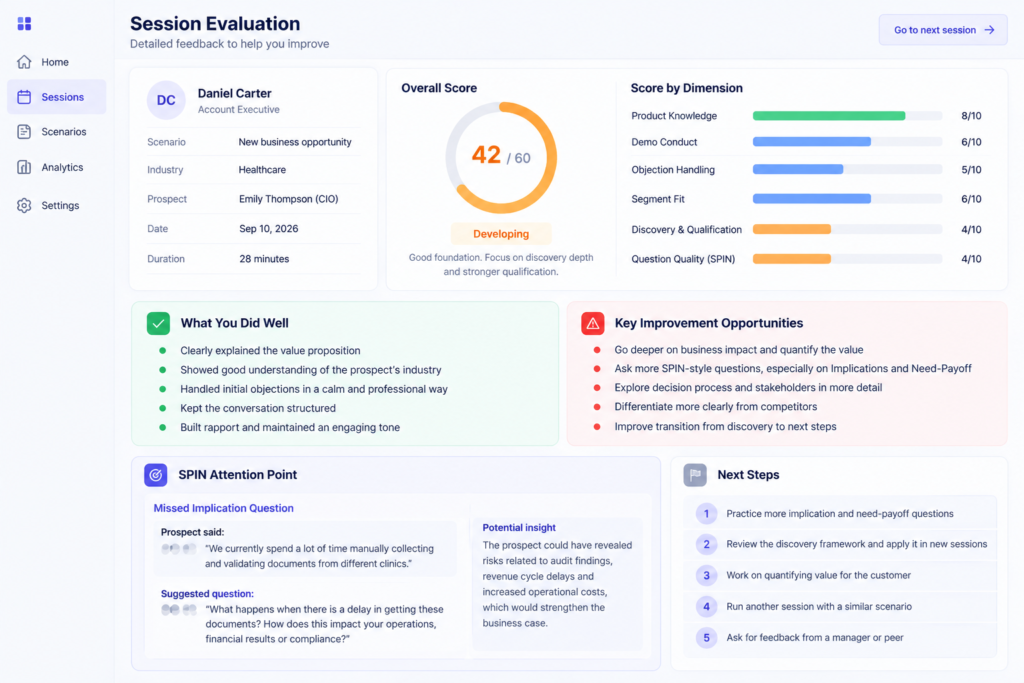
A simulation becomes far more valuable when the conversation can be evaluated consistently. After each session, the platform analyzes the interaction across multiple dimensions—such as product knowledge, meeting management, objection handling, segment alignment, the discovery and qualification phase, and question quality.
However, a score in isolation does not constitute coaching. Knowing that a conversation scored 32 out of 60 points, for example, does not tell the salesperson what needs to change in the next meeting.
The most interesting challenge was creating feedback that explained the “why.” The evaluation identifies strengths, gaps, missed opportunities, and specific moments where a more appropriate question could have altered the course of the conversation.
For the discovery phase, I incorporated established sales methodologies such as SPIN and, where appropriate, BANT. The system can identify when a salesperson recognized a problem but failed to explore its implications, or when there was an opportunity to ask a “Need-Payoff” question before presenting the solution.
Instead of generic feedback like “ask more questions,” the goal is to generate something actionable: what was said, what question could have been asked at that moment, and what additional business insights could have been uncovered.
This distinction became one of the project’s most important lessons. A score reports on someone’s performance; effective AI-driven coaching must help explain the reasons behind that result.
From Individual Practice to Continuous Development
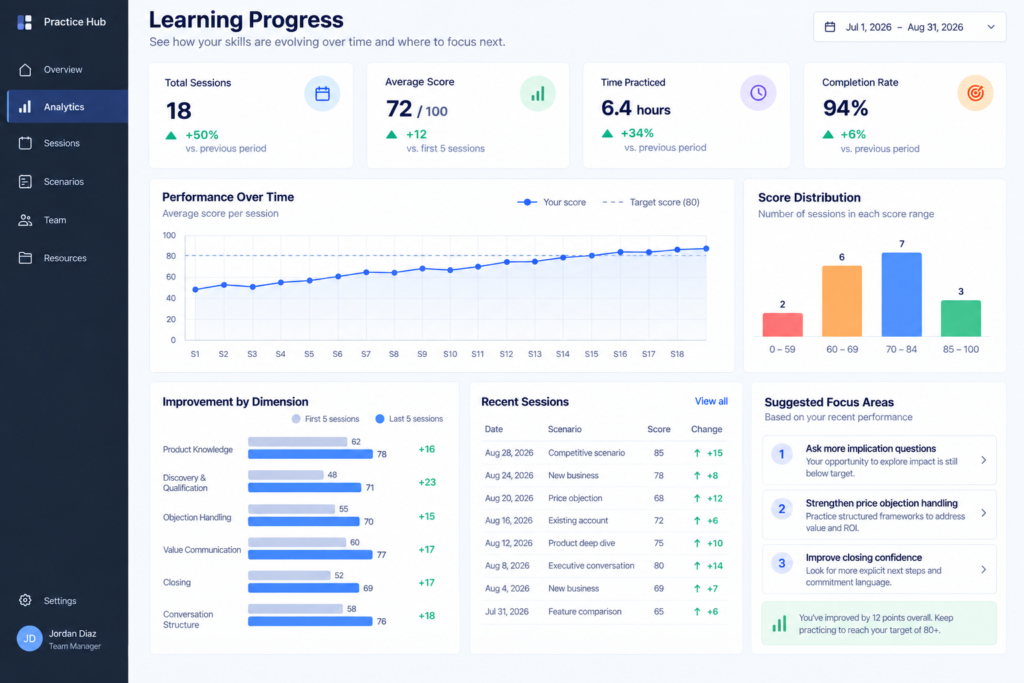
Sales enablement is not achieved through a single session. An effective training experience must demonstrate whether the professional is truly improving.
Consequently, each session becomes part of a broader development history. It is possible to track scores over time, compare individual dimensions, and identify recurring weaknesses. In this way, the system helps direct future practice toward the areas requiring the most attention.
This transforms the role of AI: shifting from a mere evaluator to an ongoing coach. The value lies not in an isolated report, but in the ability to create a repeatable learning cycle.
Practice. Evaluate. Identify the gap. Practice again. Measure whether the gap is narrowing.
This same evaluation approach can also be applied to transcripts of actual client meetings. This creates a valuable bridge between simulation and real-world work. Salespeople can practice in a safe environment and subsequently evaluate actual conversations using a consistent methodology.
Turning individual sessions into team intelligence
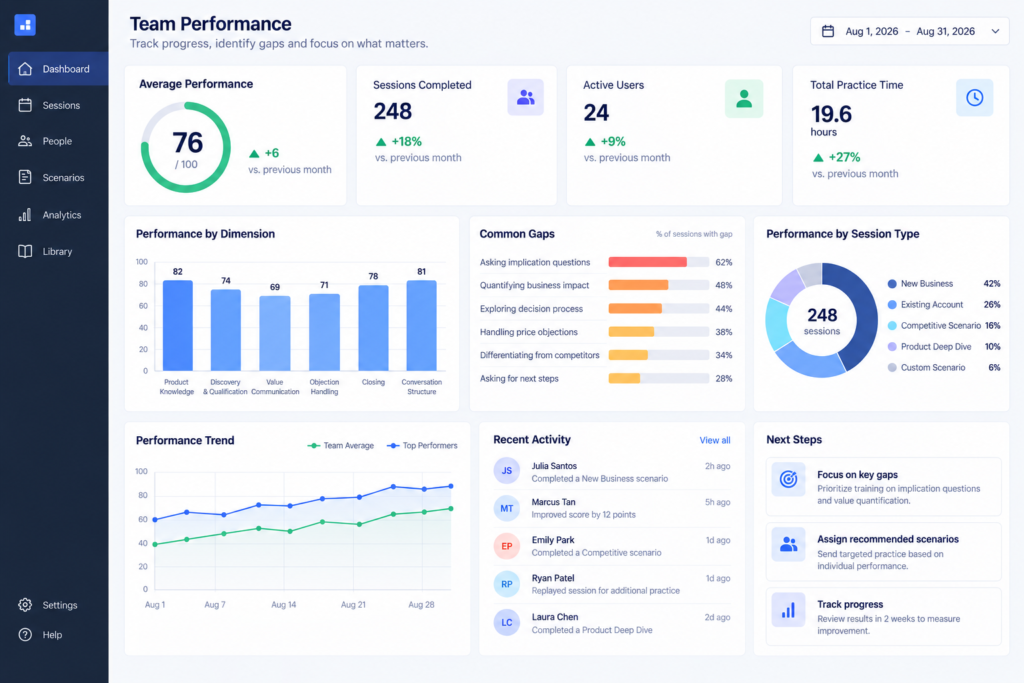
Individual coaching is just one part of the picture. At the team level, the same data can help leaders understand where to focus their enablement efforts.
Aggregated analytics can reveal common team gaps, variations based on sales scenarios, technical knowledge deficiencies, recurring issues during the discovery phase, and performance trends over time.
This transforms coaching from a practice based primarily on observation and intuition into one that is also data-driven. Leaders can identify where the team is struggling and decide which areas—such as human coaching, content, product training, or additional practice—will deliver the most value.
The goal is not to replace the manager, but to enhance their capabilities. AI can provide a consistent initial layer of practice and assessment, allowing human attention to be directed where it creates the most value.
Using the Right AI for the Right Task
Another lesson learned from the project was that an AI solution does not need to use the same model for every task.
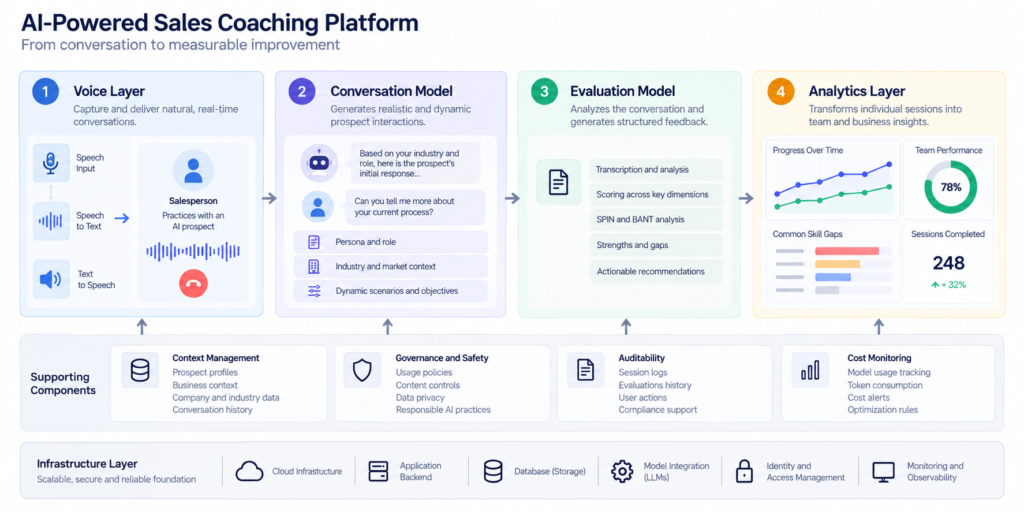
Real-time conversations, in-depth post-session evaluations, lightweight classification, context extraction, and speech processing all present distinct requirements regarding reasoning quality, latency, and cost. The architecture can route each workload to the technology best suited for that specific task.
This is a key principle of enterprise AI. The goal is not to use the most powerful model in every situation, but rather to design the optimal combination of models, workflows, controls, and economics to address the business problem at hand.
AI in Production Goes Beyond the Model
Interaction with the AI was just one part of the project. Making the idea usable within an organization required considering roles and permissions, auditability, session history, evaluation consistency, cost management, reprocessing, management visibility, and human oversight.
This is one of the major differences between an AI demonstration and an AI solution. A demonstration proves that a model can do something interesting. A production-ready solution must align with how people actually work.
It is also necessary to acknowledge that AI changes. Models improve, evaluation criteria evolve, prompts are refined, and business expectations shift. Keeping interaction history available for re-evaluation allows the learning system to evolve without losing the underlying data.
What I Learned
Building this project reinforced a broader view I have been developing about AI Transformation and AI Enablement.
Enterprise AI creates value when it is connected to a clear business problem, embedded into a workflow people can actually use, supported by the right controls, and measured against outcomes that matter.
In this case, the interesting part was not simply creating an AI prospect. It was closing the loop between practice, evaluation, coaching, measurement, and improvement.
The same principle applies far beyond sales. AI adoption does not happen when a company gets access to a model. It happens when AI becomes useful enough to become part of how the organization works, learns, and makes decisions.
For me, that is the difference between experimenting with AI and enabling an organization with AI.
About the Author
I am Bruno Zampaglione, a technology executive with nearly 20 years of experience in technology strategy, digital transformation, automation, and more recently Enterprise AI and Generative AI. I created this project to explore a practical question: how can AI improve the way people work, not just by automating tasks, but by helping them develop skills and make better decisions? Sales enablement proved to be an excellent environment for testing this idea, as the impact can be observed, measured, and continuously refined. For me, this project also exemplifies how I believe AI should be implemented within organizations: starting with a real business problem, combining the right technologies, structuring the solution with a focus on adoption and governance, and measuring whether it truly delivers value.